Dental Clinic Specialties and Departments and How Their Roles Differ
Dental clinics differ in the dental specialties they offer, their clinic departments, and the professional roles working within them. A clinic may include a general dentist alongside a dental specialist or different specialty departments, while other clinics focus on a different range of care. This structure can affect whether a clinic is suitable for a particular need, but having more specialties does not by itself mean that a clinic is more suitable for every patient.
Understanding the difference between general and specialist care helps explain what a clinic’s structure may mean when looking for care that suits a patient’s needs. The Dental clinic directory in Saudi Arabia can be used as part of the search for local options after identifying the type of care needed; clinic suitability depends on the need and the clinic’s verified characteristics, not on a general ranking of specialties.
The Difference Between a Dental Specialty, a Clinic Department, and a Treatment Service
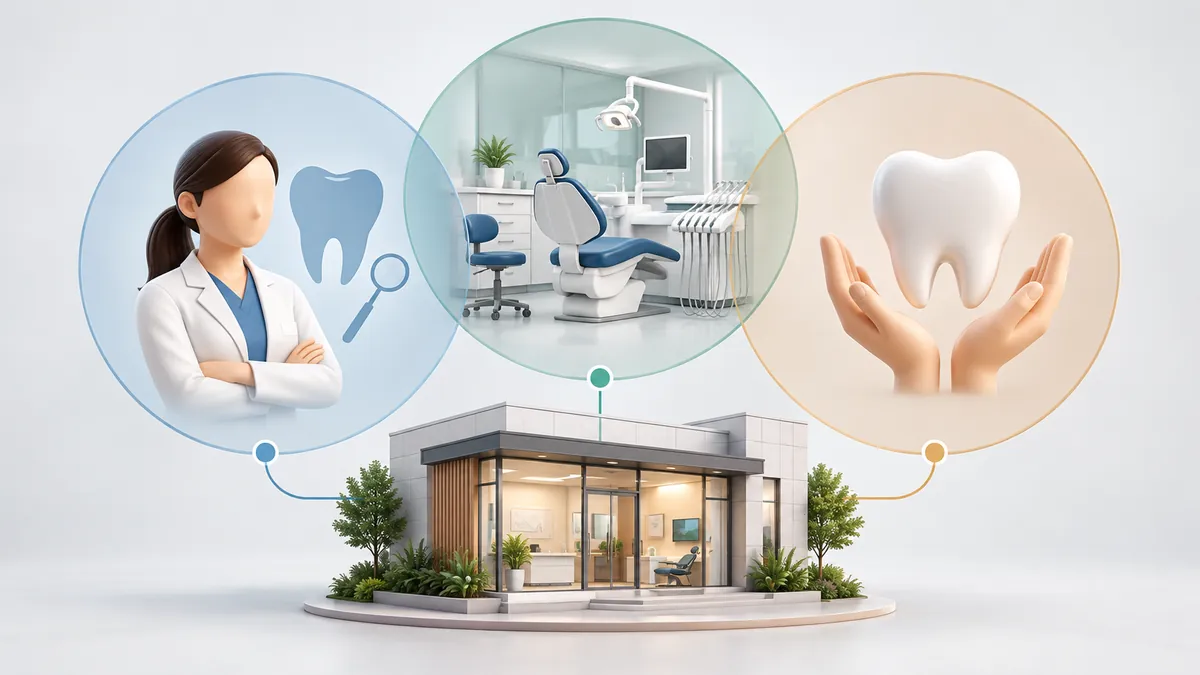
A dental specialty describes a professional field of dentistry associated with specialized expertise. A clinic department describes an organizational or clinical unit within the clinic’s structure. A treatment service describes a treatment service or capability that the clinic can provide. Understanding What is a dental clinic? helps place these concepts within the broader context of clinic organization and the care it provides.
A clinic department may be associated with a dental specialty, and a treatment service may be provided within a clinical department or in the context of a dental specialty, but this overlap does not make the concepts synonymous. The comparison distinguishes the professional field, the organizational unit, and the treatment capability described by these concepts.
| Concept | What does it describe? | Example of what it indicates |
|---|---|---|
| Dental specialty | A professional field associated with a defined area of specialized expertise | Indicates the practitioner’s professional field or specialist care |
| Clinic department | An organizational or clinical unit within the clinic | Indicates how care is organized within the clinic |
| Treatment service | A treatment service or capability provided by the clinic | Indicates a type of care that can be provided |
General Dentist vs. Dental Specialist: How Do Their Roles and Scope of Care Differ?
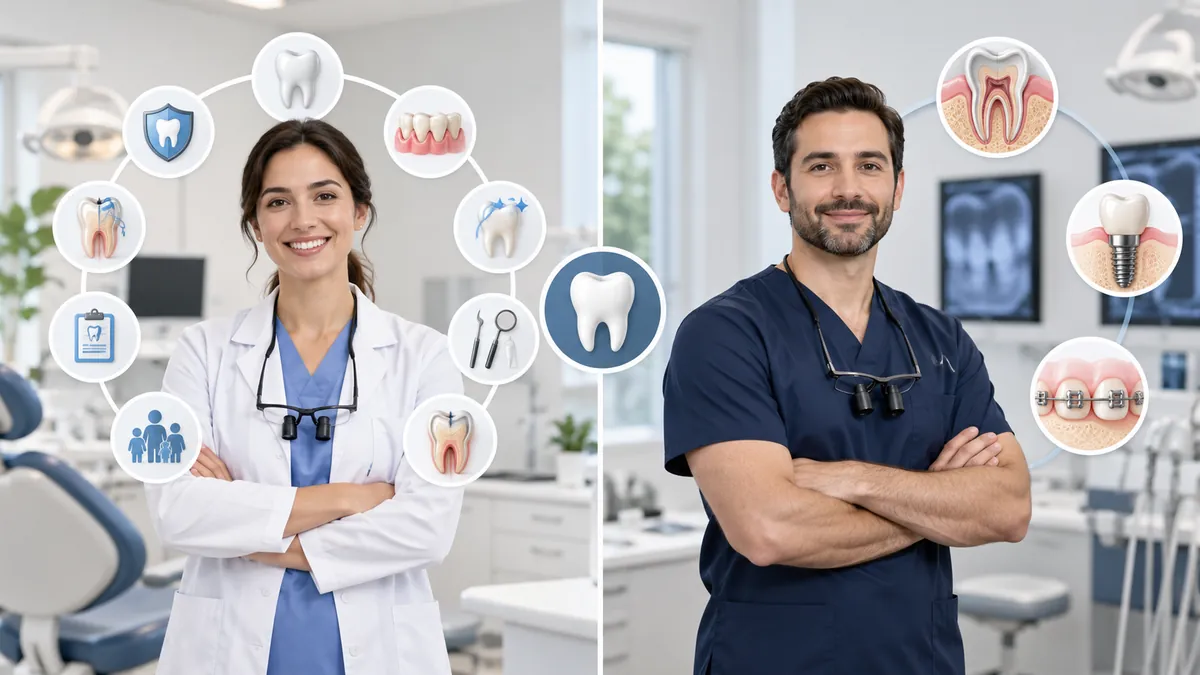
A general dentist and a dental specialist differ mainly in the breadth of care versus the focus of expertise, not in a ranking of quality or competence. A general dentist usually covers a broader range of assessment and common care, while a dental specialist focuses on a defined field and specialized expertise within a scope of practice.
| Dimension | General dentist | Dental specialist |
|---|---|---|
| Breadth of scope | Handles a broader range of assessment and common care needs | Focuses on a more defined scope within the specialty |
| Focus of expertise | Practice covers multiple areas of general care | Specialized expertise is concentrated in a defined field of dentistry |
| Typical type of need | Suited to assessment and needs that fall within the general scope of practice | May be suitable when the need requires more focused expertise or when dealing with some complex cases within the specialty |
| Limits of inference | A broad scope does not mean every case falls within that scope of practice | Specialization does not mean a specialist is better for every need or case |
This difference reflects the nature of each professional role: the general dentist’s broader scope allows assessment of varied needs, while the specialist’s expertise is concentrated in a narrower field that may suit certain specific needs or complex cases. What either practitioner can actually assess or manage may be affected by scope of practice, qualifications, available privileges, and case complexity, so a professional title alone is not enough to infer the limits of practice.
In Saudi Arabia, any specific conclusions about qualifications, privileges, or permitted procedures require official evidence that defines those limits, and the evidence available here does not provide a sufficient basis for stating them in detail. The distinction intended here is the broader scope of care of a general dentist compared with the focused specialized expertise of a dental specialist.
What Cases Does a General Dentist Handle?
A general dentist is usually an initial point for assessing and managing common oral-health needs within the dentist’s competence and scope of practice. The role includes general care and identifying the nature of the need before deciding what can be managed within that scope.

- General assessment of oral health and understanding a common dental complaint or need.
- General dental care for needs that fall within the dentist’s competence and scope of practice.
- Follow-up for oral-health needs that can be managed in a general-care setting.
- Identifying needs that may require more specialized expertise based on their nature or the complexity of the case.
These categories describe general functions and do not represent an exhaustive list of procedures or services. What a general dentist can actually assess or manage is affected by the dentist’s competence, scope of practice, facility capabilities, relevant qualifications, and case complexity. Some common needs may fall within general care, while others may require additional specialist consideration. These examples do not define an absolute scope of practice for every general dentist.
When Might a Case Require Care From a Dental Specialist?
Specialist care may become relevant when the need falls within a narrowly defined scope, when case complexity increases, or when specialized assessment or expertise is required. These circumstances indicate that a dental specialist may be suitable, but they do not identify the appropriate specialty based on the patient’s own judgment alone.

The circumstances that may make specialist care relevant can be understood through the nature of the need and the scope of care it requires:
- A need that falls within a precisely defined clinical field → may benefit from specialized expertise in that field.
- Greater case complexity → may call for a specialist assessment to determine what suits the treatment need.
- A need requiring a more focused assessment → may make the involvement of a dental specialist relevant, depending on the scope of care required.
- A need whose suitability for general care is unclear → may require a professional assessment to determine whether specialized expertise is appropriate.
Symptoms alone do not determine the appropriate specialty, because a symptom by itself is not enough to establish the nature of the need or the suitability of a specific specialty. Determining the need for specialist care depends on professional assessment, the nature and complexity of the case, and the required scope of care. The need for a dental specialist remains a possibility tied to the assessment outcome and cannot be established with certainty from symptoms alone. Specialist care may be appropriate when the assessment shows that the need would benefit from a more defined scope or specialized expertise.
Main Dental Specialties in Clinics and What Each Focuses On
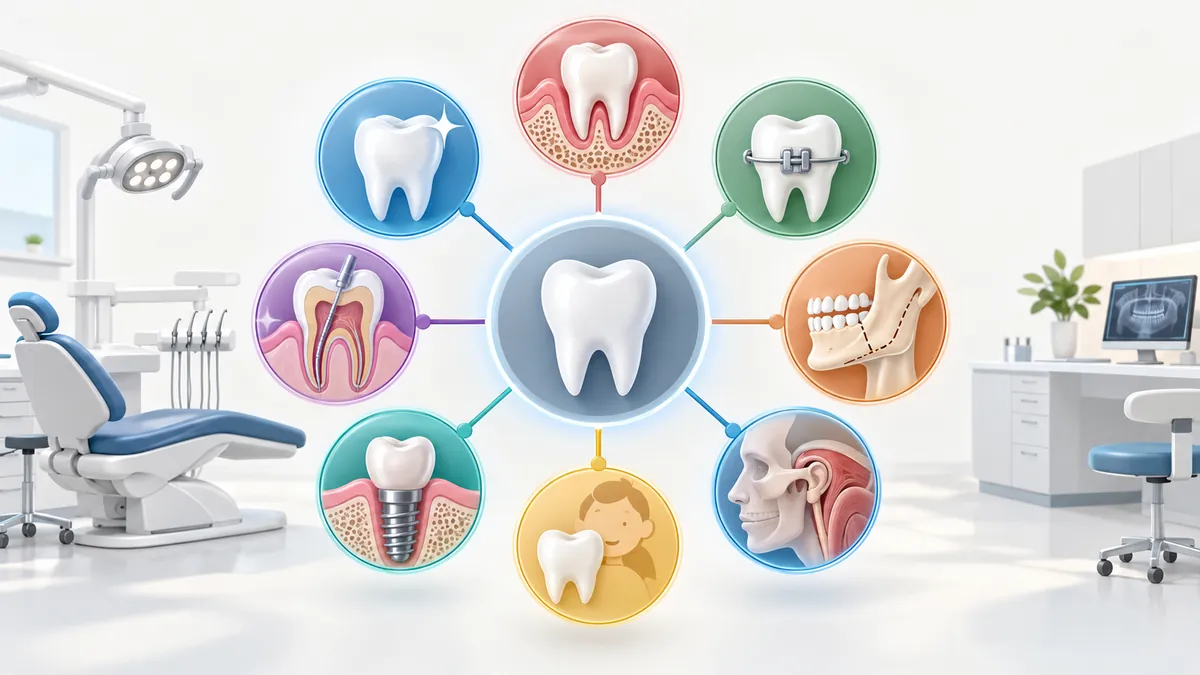
Dental specialties differ according to the clinical field they focus on, the anatomical scope they address, or the professional function performed by the dental specialist. These dimensions provide a basis for organizing specialty fields and understanding what distinguishes the scope of each one.
- Clinical field: Distinguishes the specialty by the type of clinical field in which expertise is concentrated.
- Anatomical scope: Distinguishes the specialty by the body part or tissues on which its scope is focused.
- Professional function: Some fields are distinguished by the professional function performed by the dental specialist within care.
The following specialty areas illustrate how these dimensions apply through different areas of focus, without representing an exhaustive list of all dental specialties. Specialty availability may differ from one dental clinic to another according to its capabilities and professional staffing, so the recognized scope of a specialty should be distinguished from whether it is actually available at a particular clinic.
Endodontics for Diagnosing and Treating Problems of the Dental Pulp and Roots
Endodontics is a specialty focused on the dental pulp, the root canal system, and tissues around the root, including the diagnosis and treatment of problems within this anatomical scope. The evidence supplied for this section does not include a more detailed authoritative specialty definition that would support expanding this scope.
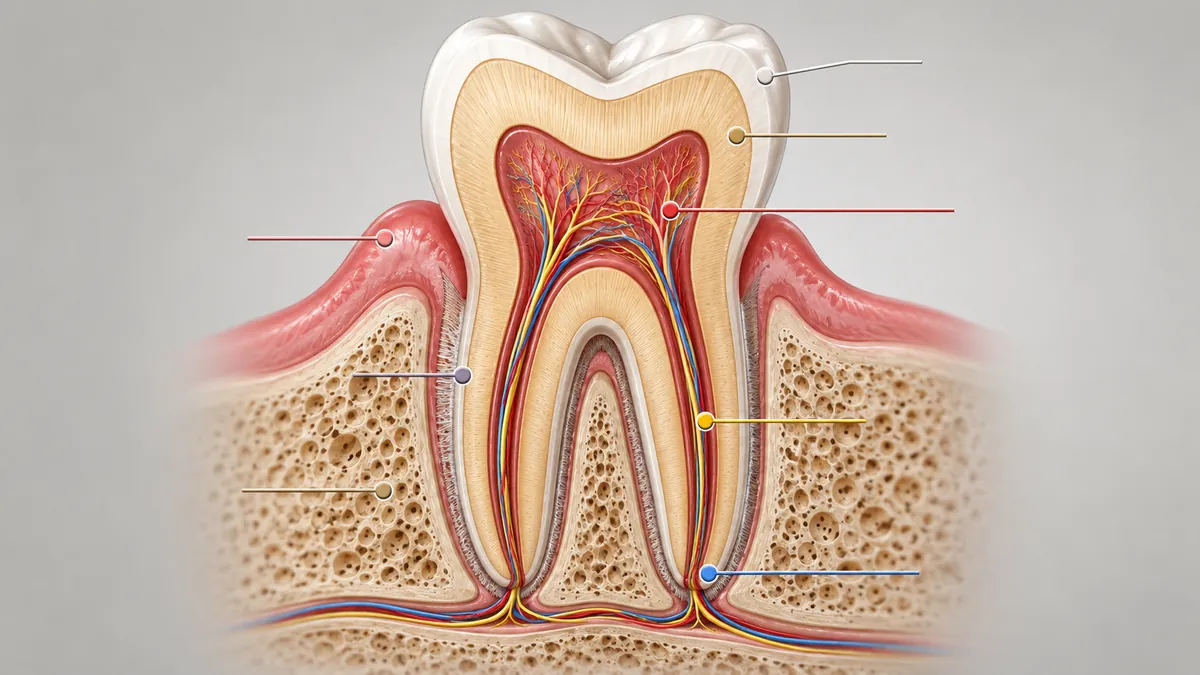
Problems involving the dental pulp, root canal, or tissues around the root may make specialist assessment in endodontics relevant, but whether a specialist assessment is needed depends on the case and cannot be inferred from a single symptom. This explains the specialty’s scope; it does not answer the procedural question of how root canal treatment is performed.
Orthodontics for Correcting Tooth Alignment and Jaw Relationships
Orthodontics is a specialty focused on tooth alignment, occlusion, and related jaw relationships. It assesses how the teeth are aligned and how they meet within this scope. This focus defines the clinical field in which an orthodontist works.
An orthodontic assessment may become relevant when problems with tooth alignment, occlusion, or jaw relationships need a more focused evaluation. Whether orthodontic specialist involvement is suitable depends on the patient’s condition, age, stage of growth, and the clinical characteristics of the case, so the need for orthodontic care cannot be inferred from the appearance of alignment alone.
Oral and Maxillofacial Surgery for Cases Requiring Specialized Surgical Intervention
Oral and maxillofacial surgery is a specialized surgical field involving the mouth, jaws, face, and related structures. This specialty focuses on cases in which surgical intervention forms part of the scope of specialist care.
The complexity or surgical nature of a case may make assessment by the relevant specialist surgeon appropriate for determining the suitable scope of care. Still, not every extraction or jaw-related problem requires oral and maxillofacial surgery; the suitability of this specialty depends on the nature and complexity of the case.
Periodontics and the Tissues Supporting the Teeth
Periodontics is a specialty focused on the gums and tissues that support the teeth, which are involved in supporting the tooth and maintaining its stability in the mouth. The periodontal tissues include the tissues surrounding the tooth that fall within the clinical field of this specialty.
More advanced periodontal needs, or cases in which the problem becomes more complex or severe, may require the expertise of a periodontist and a specialist assessment. Determining the need for this care depends on professional assessment of the case; its severity or the suitability of specialist care cannot be inferred from symptoms alone.
Prosthodontics for Restoring Missing or Damaged Teeth
Prosthodontics focuses on restoring or replacing missing teeth, severely damaged teeth, and related oral structures, with the aim of restoring function. Dental restorations and prostheses include treatment options used toward this aim according to the condition of the mouth and teeth.
This specialty is not the same as a single procedure; crowns, bridges, dentures, or implants may be used as restorative or replacement options depending on the case, without any one of them defining the specialty by itself. The choice and suitability of a procedure depend on a clinical assessment of the case and its needs.
Pediatric Dentistry for Care Related to Children’s Needs
Pediatric dentistry is a specialty focused on oral and dental care related to children’s needs, taking age, stage of growth and development, and behavioral needs into account when assessing oral health and providing care. Its scope is not limited to general dentistry applied to a younger patient; it addresses a health, developmental, and behavioral context specific to children.
The expertise of a pediatric dentist may be relevant when a child’s needs require these factors to be considered during assessment and care, without implying that every child needs specialist care. The separate evaluation of clinics serving this group and the considerations associated with them are covered in the guide Pediatric dental clinics.
The Difference Between Orthodontics and Oral and Maxillofacial Surgery
Orthodontics differs from oral and maxillofacial surgery in that orthodontics focuses mainly on tooth alignment, occlusion, and jaw relationships, while oral and maxillofacial surgery focuses on cases within the surgical scope of the mouth and jaws that may require surgical intervention. The two fields may appear close when a case involves jaw relationships or occlusion, but each has a different professional focus.
| Dimension | Orthodontics | Oral and maxillofacial surgery |
|---|---|---|
| Primary focus | Tooth alignment, occlusion, and jaw relationships | Surgical cases involving the mouth, jaws, and jaw structure |
| Nature of intervention | Focuses on orthodontic management within the specialty’s scope | Includes surgical intervention when the case falls within the surgical scope |
| When the roles may overlap | When the case includes orthodontic aspects related to jaw relationships | When the same case includes a surgical aspect related to jaw structure |
Specialty collaboration may occur in some shared cases that combine needs related to tooth alignment or occlusion with a surgical aspect involving the jaws. In such cases, an orthodontist and an oral and maxillofacial surgeon may work together within their different roles, while the need for that collaboration remains dependent on professional assessment of the case.
How Are Dental Clinic Departments Organized According to Available Specialties?
Dental clinic departments may be organized according to the specialties available and the scope of care the clinic supports, so some departments represent defined clinical fields while other needs are managed within general care. The presence of a particular specialty does not necessarily mean there is a separate department for it, because clinic organization may vary according to facility size, team composition, and operational capabilities.
A clinic may include a department or area dedicated to general care alongside specialty fields such as orthodontics, endodontics, periodontics, or other specialties that are actually available. A clinic department describes how care is organized within the facility, while a specialty describes the professional field of expertise; the two may be related without being the same concept.
The General Department for Cases Within the Scope of General Dentistry
The general department is an organizational component of a dental clinic that provides assessment and general care for cases within the scope of general dentistry. It operates within its available scope of practice to cover a broad range of general dental needs without implying that it includes every type of care.
The general department may act as an entry point for assessment before a specialty department needs to become involved, and it may also help coordinate a transfer of care when the case requires a more specialized scope. Department services, practitioner privileges, and practitioner competence vary by clinic, dentist, and practice setting, so the department’s actual capabilities should be verified and cannot be inferred from the name “general department” alone.
Specialty Departments for Cases Requiring a Defined Field of Dentistry
Specialty departments are organizational units centered on specialized expertise or a defined clinical field within a dental clinic. A specialty department connects that field with the organization of care in which a dental specialist may participate within the scope of that expertise.
The availability of a specialty and a dental specialist may indicate that a clinic can support needs within that clinical field, but department names, staffing, and scope of work may vary between clinics. Specialty availability, staffing, and the actual scope should be verified to determine the clinic’s capability; a department name alone does not establish a specific specialist capability.
Multispecialty Clinics and Care Coordination Between Departments
Multispecialty clinics involve participation from more than one dental specialty when different aspects of a need require distinct professional expertise. This organization is not limited to having several specialties available; it is also associated with actual coordination among them when needed.
- Care coordination: Describes how participation is coordinated between the relevant departments and specialties.
- Continuity of information: Relates to making the information needed for communication available to the parties involved in care.
- Responsibility for care: Relates to clarity about each department’s or specialty’s responsibility for the part that falls within its scope.
These features may support clearer coordination when multiple specialties are involved in different aspects of a need. How coordination, continuity of information, and allocation of responsibility are applied varies with the clinic’s actual organization. The level of these features cannot be assumed from the presence or names of departments alone. Simply listing several specialties does not establish that actual care coordination exists between them.
When Is a Patient Referred From a General Dentist to a Specialist?
Referral to a specialist becomes relevant when a professional assessment determines that the patient’s need can be managed more appropriately through the expertise of a dental specialist or through specialized resources beyond the suitable general-care setting. Greater case complexity alone does not mean an automatic referral; referral to a specialist depends on what the assessment shows about the scope of practice, expertise, and resources required.
The decision to refer a patient depends on how well the need fits the general dentist’s available scope of practice and on the level of expertise the case requires. Case complexity is also considered when it changes the type of expertise or resources needed to manage the case. Specialist referral may become more relevant if assessment shows a need for a dental specialist or for specialized resources that are not available in the current general-care setting. The relationship between these circumstances and the relevance of referral can be summarized as follows:
- A need outside the general scope of practice appropriate to the case → referral to a specialist may become relevant.
- Complexity requiring more specialized expertise → may indicate that involvement of a dental specialist is appropriate, based on professional assessment.
- A need for specialized resources not available in the current care setting → may support considering referral to a specialist who can provide the appropriate resources.
- A need remaining within the available scope of practice, expertise, and resources → does not make specialist referral an automatic outcome.
Any formal requirements in Saudi Arabia concerning referral procedures or professional privileges require current official evidence, and the evidence available here does not provide a sufficient basis for defining them. Patient referral remains conditional on professional assessment that determines how the patient’s need fits the available scope of practice, expertise, and resources.
Referral When a Case Exceeds the Scope of General Practice
Referral becomes relevant when the needs of a case do not fit the appropriate general scope of practice and require specialized expertise or resources beyond what can be provided within general care in that setting. Determining this boundary depends on the dentist’s assessment and actual scope of practice, which may vary with qualifications and the practice setting.
Case complexity may be a reason to consider referral when it changes the level of expertise or resources required. A need for specialist assessment may be another reason when the case requires specialized expertise to determine suitable care. A specialized procedure may also become a reason for referral if it falls outside the general scope of practice appropriate to the case, with the final decision still tied to the dentist’s assessment.
Cases That May Require Collaboration Between More Than One Dental Specialty
Collaboration between more than one dental specialty may become relevant when a case includes interconnected needs that fall within different specialty scopes, so one field does not account for every aspect of the required care. This collaboration depends on the nature of the case and what professional assessment reveals, not merely on the presence of several specialties within the clinic.
Case complexity may combine considerations involving two or more specialties, making coordination between specialties appropriate depending on the need. Some cases may require complementary specialist expertise when one aspect of care affects another aspect that falls within a different specialty. Assessment by the dentists involved determines the need for collaboration, the role of each specialty, and responsibility for care within its scope, without assuming that every complex case requires a multidisciplinary team.
How Do Available Specialties Affect Whether a Dental Clinic Suits Your Needs?
Available specialties affect whether a dental clinic suits a patient’s needs only when the clinic has documented expertise that matches the relevant need. The number of specialties listed alone does not establish clinic suitability; the criterion is whether the need matches the appropriate specialty and whether that specialty is actually available.
To assess clinic suitability from the perspective of specialties, distinguish between a specialty appearing in the clinic’s information and that specialty being relevant to the actual need. This information becomes useful for a decision when documented expertise and the availability of the specialist associated with the need can be verified. The assessment can be organized around the following criteria:
- Presence of the specialty: If the specialty is listed in verified clinic information, this shows that it is among the clinic’s stated capabilities, but that alone is not enough to judge whether the clinic suits a specific need.
- Relevance of the specialty to the actual need: If the patient’s need falls within the field served by an appropriate specialty, the presence of that specialty becomes more relevant to whether the clinic suits the need.
- Documented expertise: If expertise associated with the relevant specialty can be verified, the clinic’s information becomes more useful for assessing whether the need matches its specialist capability.
- Specialist availability: If the appropriate specialist’s availability can be verified when specialist input is needed, that supports alignment with the need and the clinic’s suitability from this perspective.
A dental clinic’s suitability from the perspective of specialties remains one dimension of assessment and should be interpreted alongside other relevant clinic information rather than treated as a complete judgment of the clinic. To move from this criterion to the broader comparison framework, the guide Choosing a clinic based on your needs explains selection factors in a broader way.
Matching the Nature of the Need to the Appropriate Dental Specialty
The nature of the need and the area of the problem can help identify an appropriate specialty as a possible starting point, but they do not determine the correct dental specialist with certainty and do not constitute a diagnosis. Professional assessment remains necessary to confirm whether the specialty field is suitable or to redirect the case when needed.
The following broad need categories can be used to indicate a possible specialty without turning them into diagnostic rules. The process may begin with a general dentist when the area of the problem is unclear. After professional assessment, the patient may be referred to a dental specialist or redirected to another field if the interpretation of the need changes.
- A need related to the dental pulp or roots: May point toward endodontics, while the suitability of this specialty remains conditional on assessment.
- A need related to tooth alignment, occlusion, or jaw relationships: May point toward orthodontics, and the path may change if assessment identifies an aspect that falls within another field.
- A need of a surgical nature involving the mouth or jaws: May make oral and maxillofacial surgery an appropriate specialty to consider, but this depends on the nature and assessment of the case.
- A need related to the gums and tissues supporting the teeth: May point toward periodontics, with the possibility of redirection after assessment if the problem falls within a different field.
- A need involving restoration or replacement of missing or severely damaged teeth: May be associated with prosthodontics, while professional assessment determines whether this is the appropriate specialty for the case.
When Is General Care Enough, and When Can a Specific Specialty Be Useful?
General care may be sufficient when the nature of the need falls within the scope of general dentistry and can be assessed and managed within the general dentist’s competence and available scope of practice. The availability of a specific specialty may become more relevant when the need requires specialized expertise or a more focused assessment, without implying that every complex case automatically needs a dental specialist.
- A need that clearly falls within general care: A general dentist may be an appropriate point for assessment and care when the dentist’s expertise and the clinic’s capabilities support managing it.
- A need that is unclear at the outset: It may begin with a general assessment to identify its nature, after which a decision can be made about whether general care is sufficient or involvement of a specific specialty is relevant.
- A need associated with a defined specialty field: The availability of a dental specialist may be useful when the problem area requires more focused expertise within that specialty.
- A need with increasing complexity: Specialist care may become more suitable if assessment shows that the case exceeds what can be managed within the available general scope of practice.
The boundary between general and specialist care is not determined by symptoms alone or simply by the presence of a specialty within the clinic. It depends on professional assessment of the nature and complexity of the need, scope of practice, and available capabilities. The assessment may result in continued care with a general dentist, involvement of a dental specialist, or redirection of the case to the appropriate specialty field.
A Service Being Available at a Clinic Does Not Necessarily Mean the Associated Specialist Is Available
The availability of a treatment service at a dental clinic and the presence of the associated dental specialist are two separate clinic attributes. Service availability shows that the service is available within the clinic’s stated capability, but by itself it does not establish the qualifications or professional specialty of the person providing it.
Service availability and specialist availability should be interpreted separately using verified information about the clinic and its practitioners. A service may be associated with a particular department or a practitioner with specific qualifications and a defined specialty, but identifying who actually provides it requires verification through clinic information or suitable official evidence. To interpret the scope of the service itself separately, the guide Dental clinic services explains the context of services that clinics may provide. The presence or qualifications of a specialist should not be inferred from a marketing description of a service alone.
| Attribute | What does it establish? | What does it not establish by itself? |
|---|---|---|
| Service availability | Establishes that “the service is available” when its availability is documented in the clinic’s information. | Does not by itself establish that “the specialist is available” or that the service provider holds a particular specialty or set of qualifications. |
| Specialist availability | Establishes the presence of a dental specialist in the specified specialty when supported by verified information. | Does not by itself establish that every service associated with that specialty is available at the clinic. |